
Digital Insights / Business AI guide
AI Agents vs Chatbots: What Every Business Should Know Before Implementation
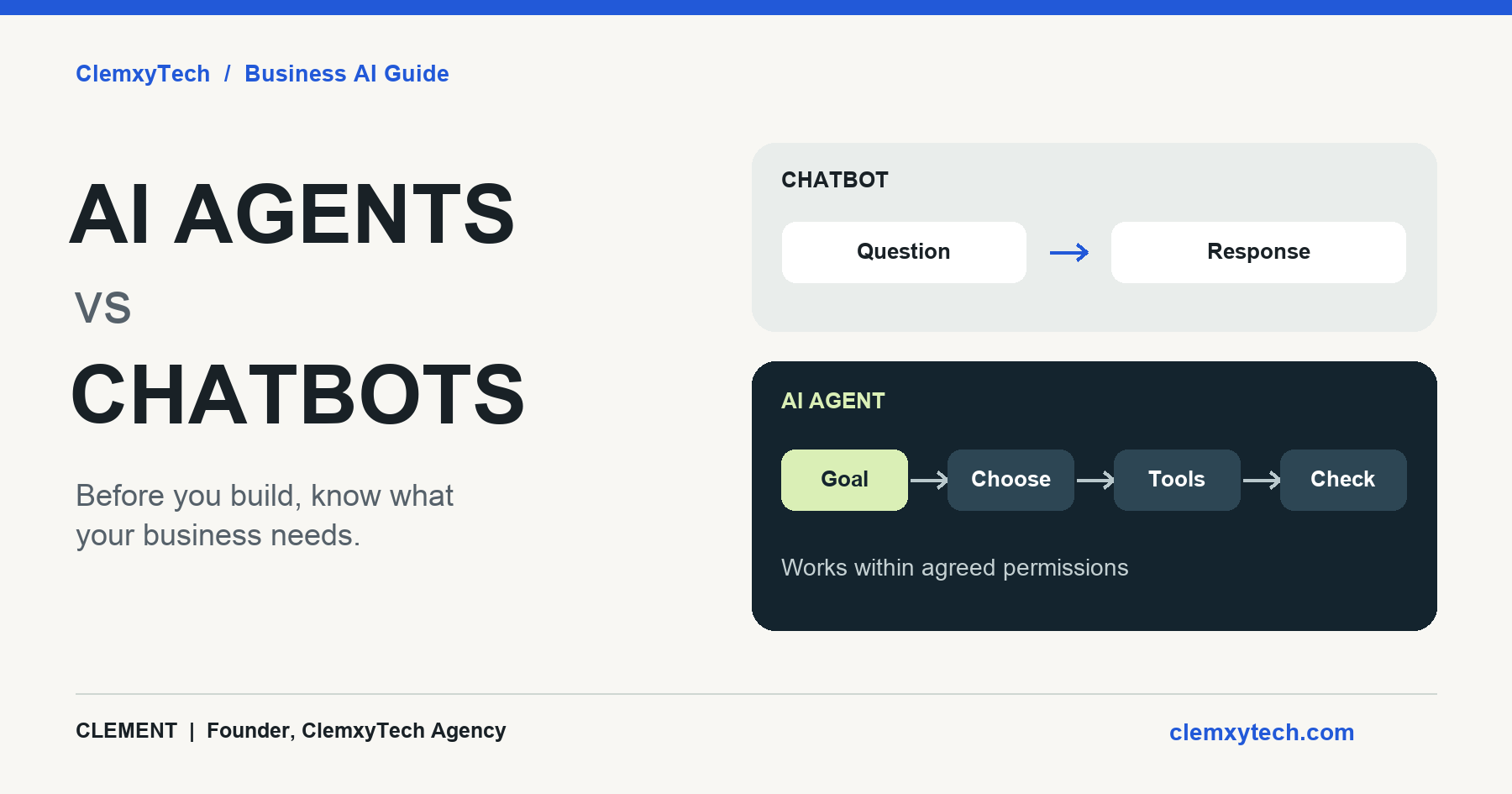
A customer visits your website after closing time and asks whether you can help with a project. Your chatbot explains your services, collects an email address, and promises a reply. That may be exactly what your business needs.
Now imagine the same conversation leading to a search of your project records, a check of your team’s availability, and a draft proposal for someone to review. The conversation looks similar. The work happening behind it is very different.
That difference matters when you are choosing between an AI agent and a chatbot. It affects the systems you connect, the permissions you grant, the budget you need, and who takes responsibility when something goes wrong.
Before buying software or commissioning a build, decide what a successful customer interaction should actually accomplish.
If you already have a workflow in mind, book a free consultation with ClemxyTech. Tell us where the work gets stuck, and we can discuss whether a chatbot, an agent, or a simpler automation fits the job.
The difference is in who decides the next step
A chatbot is a conversational interface. Some follow scripts and menus. Others use AI to interpret a question and produce a response. Modern chatbots can also retrieve account information, create tickets, or start transactions through connected software. Having a chat window does not tell you how capable the system is. IBM’s overview of chatbots describes this range of capabilities.
An AI agent uses a model to help decide how to carry out a task. Given a goal, it can select tools, inspect the results, and choose what to do next within the limits you set. It might ask for missing information or stop for human input along the way. OpenAI’s practical guide to agents identifies model-directed workflow execution and tool use as central features.
There is also a useful middle ground: a fixed workflow with AI inside it. For example, AI can classify an enquiry, while ordinary software routes it to a department using rules you have already approved. The model helps interpret the message; your application still determines the sequence.
These categories overlap in real products. A chatbot can be the front door to an agent. A chatbot connected to one booking function may still follow a fixed process. Retrieving company documents to improve an answer does not, by itself, make a system an agent. Ask a supplier to show you who controls the next step, rather than relying on the product label.
Start with the work your team keeps repeating
Take a small consulting business that receives the same questions about services, locations, and how to get started. A well-maintained chatbot may handle those enquiries comfortably. Give it approved information and an easy route to a person when the conversation needs one.
For appointment requests, a structured form or a fixed booking workflow may be enough. If the steps are always the same, allowing a model to invent a new route adds little value.
An agent becomes more interesting when the next step depends on what it finds. Consider a sales assistant that reviews an enquiry, searches relevant project examples, identifies missing requirements, and prepares a tailored briefing for your team. Different enquiries could require different searches and follow-up questions. The useful outcome is a better-prepared human conversation.
Those are illustrative scenarios, not promises of what any particular product will deliver. Each one needs the right data, integrations, and testing. Anthropic’s guidance on building agents distinguishes predefined workflows from model-directed agents and recommends starting with the simplest approach that can do the job.
Our recommendation at ClemxyTech is to write down one recurring task before discussing tools. Who starts it? What information is needed? What counts as finished? Where does a person need to make a decision? A clear answer makes the technology choice much easier.
A convincing conversation is only part of the test
A demo can show a smooth answer without showing whether the underlying record was updated correctly. During a supplier demonstration, ask to see the actual result in the connected system. A message saying “your appointment is booked” should correspond to a real appointment.
Bring examples from your own business, including awkward ones. Try an incomplete enquiry, a request outside your services, an outdated policy, a disconnected calendar, and a customer who changes their mind. Check whether the system asks a sensible question, escalates, or quietly guesses.
Also ask what happens after a timeout. If a customer clicks twice, could two appointments or records be created? Who can spot the error and put it right? These are practical acceptance questions for your implementation team, even when the sales presentation concentrates on conversational quality.
Access to your business systems changes the responsibility
An AI system can produce an incorrect answer. Connecting it to customer records, email, or payment tools can turn that error into an action with wider consequences. Decide which actions it may take, which it may only prepare, and which require a person’s approval.
For an initial sales pilot, for example, you might permit the system to read selected service information and draft a response, while leaving proposal approval and sending with your team. Permissions should be enforced by the application and connected systems. A prompt telling the model to behave is only one part of the design.
External content introduces another risk. A message or document can contain instructions that try to redirect the model, a problem known as prompt injection. OWASP’s prompt-injection guidance explains why access restrictions, validation, separation of untrusted content, and human approval for sensitive operations matter. It also makes clear that retrieving documents or fine-tuning a model does not eliminate this risk.
Before connecting customer data, ask where it will be processed, who can access it, how long it will be retained, and how it can be deleted. Agree who owns the system after launch. The NIST Generative AI Profile is a useful reference for treating risk management as part of the system’s ongoing design, use, and evaluation.
Budget for a working service
The monthly software fee is only one line in the budget. Ask for the cost of connecting your systems, preparing business information, testing, staff review, monitoring, and maintenance. Usage charges may also include model calls and the tools the system invokes. An agent can make several calls while working through one request, so ask for a realistic usage estimate with clear assumptions.
A useful measure is the total operating cost divided by the number of tasks completed correctly. Include the time your team spends checking and fixing the output. A cheap conversation that creates extra work can be expensive in practice.
Agree a baseline before the pilot. You might measure how long your team currently spends preparing a qualified enquiry, then compare that with the pilot’s review time, corrections, and completed handovers. For a support chatbot, look at resolution quality and repeat contacts as well as response speed. Faster replies help only when customers can move forward.
Be cautious about a return-on-investment estimate built entirely on projected hours saved. Some time will move into supervision and upkeep. Use the pilot to find out how much work has actually been removed and whether your team can use the recovered time productively.
Give the pilot a clear boundary
Choose one service, one team, and a defined group of requests. Start with limited access. Have a named person review the results and a straightforward way to pause the system. Expand only when the evidence supports it.
Ask your implementation partner for a written description of the workflow, its data sources, the actions it can take, the approval points, and the handover process when it cannot continue. Include the measures you will review and the person responsible for keeping business information current.
You do not need to settle your entire AI strategy in the first project. A useful first result could be fewer repetitive questions, cleaner enquiry records, or a shorter preparation time before a sales call. Choose the outcome that matters to your business and build around it.
Let’s work out what your business actually needs
If you are considering a chatbot or an AI agent, bring us one task that is slowing your team down. Tell us what happens today, which tools are involved, and what you would like to improve. We can use the initial conversation to discuss scope, practical options, and a sensible starting point.
Want to know who you would be working with? Meet Clement, founder of ClemxyTech, and explore his work in AI, digital products, and quality assurance.
Our team responds to consultation enquiries within two business days. The initial conversation is free.
You may also find 5 Signs Your Business Needs Automation useful as you choose where to begin.