
Digital Insights / Business AI guide
How AI Evolved: From Predictive Models to Generative AI and Agents
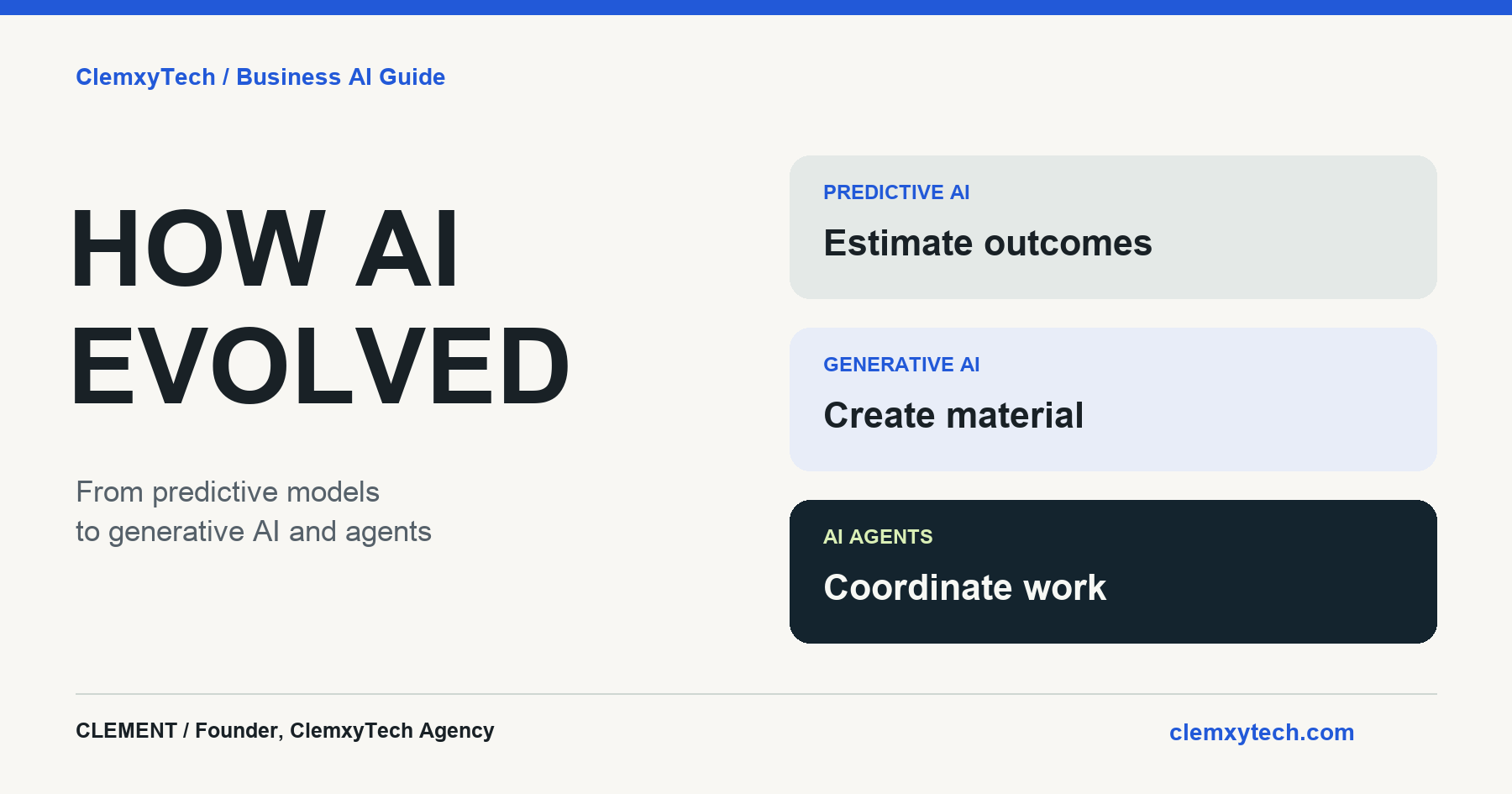
A retailer deciding how much stock to order, a freelancer preparing a proposal, and a sales team following up an enquiry might all be using AI. The software could be doing quite different jobs in each case.
One system estimates what is likely to happen. Another produces a draft. A third can work through a task using connected tools. Much of the confusion around AI comes from treating those capabilities as though they were interchangeable.
Following the development of AI makes the differences easier to understand. It also helps answer a practical question: what kind of help does your business actually need?
AI was working long before the chat window
Before conversational tools became widely familiar, businesses were already using statistical and machine-learning models to work with patterns in data. Predictive AI estimates outcomes such as likely demand or the chance that a customer will leave. IBM’s explanation of predictive AI describes this use of historical information to anticipate possible outcomes.
For our retailer, that might mean looking at previous sales, seasonal changes, and other relevant information to estimate how much stock to buy. The output is a forecast. Someone still has to decide how to use it, taking account of the budget, storage space, and what is happening in the business.
Deep learning expanded what models could recognise in complex inputs. One important result came in 2012, when Alex Krizhevsky, Ilya Sutskever, and Geoffrey Hinton reported a deep neural network for image classification, trained using GPUs. Their ImageNet classification paper documented a substantial improvement over earlier results on that benchmark.
That was an advance in recognising patterns in images. It was not a general-purpose business assistant. Different systems continued to be built for different tasks, and their usefulness depended on the information available and how their output was put to work.
Language made AI easier to work with
A major development in language modelling arrived in 2017 with the Transformer architecture. Its attention mechanism helps a model represent relationships between parts of a sequence. Google’s original explanation of the Transformer showed how this could be applied to translation and language understanding.
The significance for a business owner is easier to see in the tools that followed. Instead of working only through specialist interfaces, people could increasingly describe a task in ordinary language and receive a useful response.
OpenAI introduced ChatGPT on 30 November 2022 as a conversational model that could respond to follow-up questions. The original launch announcement also acknowledged that it could produce plausible but incorrect answers. Ease of use and reliability were separate questions from the beginning.
Generative AI creates material such as text, images, or code. A freelancer can use it to prepare a first draft of a proposal or explore possible approaches to a project. The freelancer still needs to understand the brief, check the work, and make decisions about what to deliver.
The distinction between predictive and generative AI is mainly about the task and the intended output. Generative language models also use prediction internally as they produce text. A useful business distinction is whether you need an estimate about an outcome or material that someone can review and use.
A good draft still leaves work to do
Consider a supplier enquiry arriving at a small business. A language model might summarise the message and suggest a reply. That can help the person handling the inbox, but the message still needs to be checked against current stock, delivery commitments, and the customer’s actual request.
If the user has to copy information between the inbox, a spreadsheet, and a customer record, the surrounding process remains largely manual. Improving the draft solves one part of the job.
For freelancers, the same distinction matters. Producing a page of copy quickly does not settle the audience, the offer, or whether the information is accurate. Generating code does not establish that it meets the client’s requirements or works properly with the rest of the application.
This is where an AI implementation can disappoint. The output looks impressive, while the people responsible for the work are still doing the same checking, copying, and chasing as before. A useful evaluation follows the task all the way to completion.
Agents connect the model to a wider task
An AI agent adds a degree of model-directed control over the work. Rather than responding once and stopping, it can select a tool, inspect the result, and choose another step towards a goal. OpenAI’s practical guide to building agents describes models, tools, and instructions as the core components, with boundaries around how the system operates.
In an illustrative sales workflow, an agent could review an enquiry, look for relevant information in approved records, and prepare a briefing for the team. If an important detail is missing, it could ask for it or leave the task for a person. The design should specify whether it can only prepare a response or also send one after approval.
Connecting a model to tools does not automatically make every workflow agentic. A process can use AI to interpret a message while ordinary code controls every subsequent step. Anthropic’s guide to effective agents makes this distinction between predefined workflows and agents that direct their own tool use. It recommends increasing complexity only when the task needs it.
For a business, that distinction affects testing and responsibility. A fixed process follows an agreed route. A model-directed system needs room to choose a route, together with clear limits on what it may access and change. If you are weighing the options, our guide to AI agents and chatbots looks more closely at implementation.
The newer approach does not replace every older one
A retailer could use a predictive model to estimate demand, generative AI to draft a purchasing summary, and an agent to gather the information needed for a review. A person might approve the order. Those capabilities can sit in the same process.
Equally, a shop may only need a reliable stock alert. A small agency may only need incoming enquiries organised properly. Adding more autonomy would need a clear reason, because someone will have to maintain and supervise the system.
My starting point for this kind of work is the process itself. Where does information enter? What needs to happen next? Which decision takes up a person’s time? What would make the result dependable enough to use? Those questions are more helpful than choosing a tool first.
That is the connection between the history of AI and a sensible business decision today. The range of available capabilities has grown. Choosing well still depends on understanding the work.
What this means for businesses and freelancers
For a business owner, the next useful step is to identify one process that is causing a recurring problem. It could be a slow response to enquiries, a report that takes too long to prepare, or information that staff keep having to find again. Describe the current process before deciding how much of it AI should handle.
For a freelancer, it is worth examining where your judgment contributes to the result. You may use AI to research an approach or prepare material, while taking responsibility for the brief, the implementation, and the final checks. Be able to explain those contributions to a client.
You can see how I bring together website development, full-stack products, automation, and AI quality work on my Clement page. It includes my project portfolio and background, so you can get a clearer picture of the person behind ClemxyTech.
If you have a business process you would like to improve, bring us the actual task. Tell us which tools your team uses, where the work gets stuck, and what a useful outcome would look like. We can discuss a practical starting point in a free initial conversation.
Our team responds to consultation enquiries within two business days.