
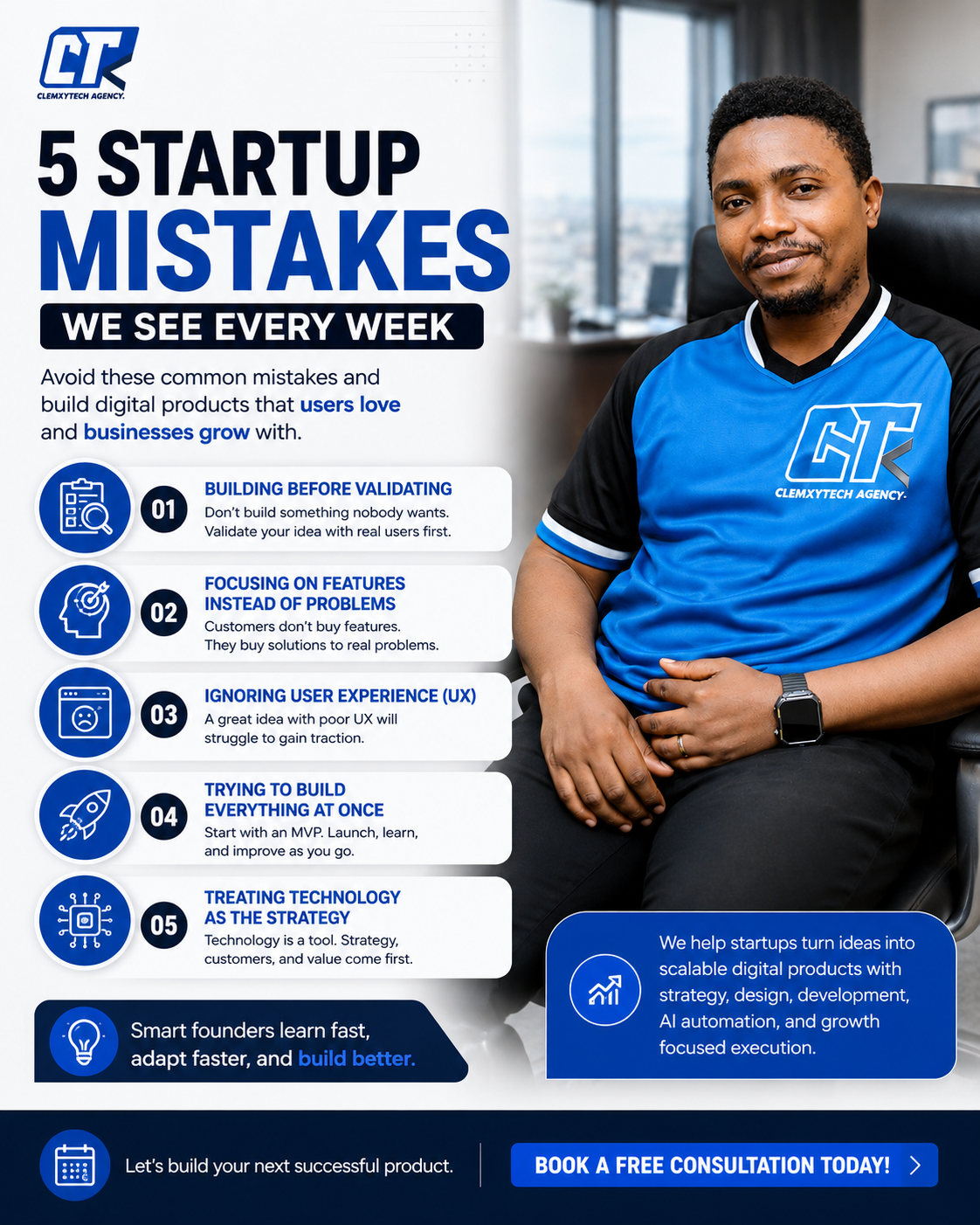
Startup Mistakes We See Every Week

Building a startup is hard. Building the wrong product is even harder.

After working with founders across different industries, we’ve noticed the same mistakes appear again and again and they often cost startups valuable time, money, and momentum.

Here are 5 of the most common mistakes we see:

1️⃣ Building Before Validating

Many founders spend months (and thousands of dollars) building a product before confirming that customers actually want it.

Validate first.
Build second.

Talk to users. Test assumptions. Gather feedback early.


2️⃣ Focusing on Features Instead of Problems

Customers don’t buy features.

They buy solutions.

The most successful products solve a clear, painful problem better than existing alternatives.


3️⃣ Ignoring User Experience (UX)

A great idea with poor user experience will struggle to gain traction.

If users can’t quickly understand how your product works, they’ll leave.

Simple beats complicated every time.


4️⃣ Trying to Build Everything at Once

One of the fastest ways to delay a launch is trying to create the “perfect” product.

Start with an MVP.

Launch.
Learn.
Improve.

The market is the best product advisor you’ll ever have.


5️⃣ Treating Technology as the Strategy

Technology is a tool.

Business strategy comes first.

Before writing a single line of code, ask:

✔️ Who is the customer?
✔️ What problem are we solving?
✔️ How will we acquire users?
✔️ How will the business generate revenue?

The answers to those questions matter more than the tech stack.


The startups that succeed aren’t always the ones with the biggest budgets or the most advanced technology.

They’re usually the ones that stay closest to their customers and execute consistently.

At ClemxyTech Agency, we help founders turn ideas into scalable digital products through strategy, design, development, AI automation, and growth-focused execution. 🚀

Founders: What’s been your biggest challenge while building a product?

5 Signs Your Business Needs Automation

Most businesses don’t have a growth problem.

They have a repetition problem.

Your team spends hours every week on tasks that could be handled automatically, leaving less time for strategy, sales, and customer relationships.

Here are 5 signs it’s time to automate your business:

1️⃣ You’re Doing the Same Tasks Every Day

👉 Manually sending emails.

👉 Updating spreadsheets.

👉 Assigning tasks.

👉 Following up with leads.

If a process happens repeatedly, it can likely be automated.

2️⃣ Leads Are Falling Through the Cracks

A prospect fills out your contact form.

Then…

Nobody follows up for hours, or worse, days.

AI agents can instantly:

✅ Respond to inquiries

✅ Qualify leads

✅ Schedule meetings

✅ Route prospects to the right team member

No opportunity gets missed.

3️⃣ Your Team Spends More Time on Admin Than Growth

If your employees spend most of their day updating records, managing data, or answering routine questions, they’re not working at their highest value.

Automation allows your team to focus on:

📈 Revenue generation

🤝 Customer relationships

🚀 Business growth

4️⃣ Customer Support Questions Are Repetitive

“What’s your pricing?”

“How do I get started?”

“Where’s my order?”

If you’re answering the same questions repeatedly, AI can handle common inquiries 24/7 while your team focuses on more complex conversations.

5️⃣ Growth Feels Chaotic

As your business grows, manual processes become bottlenecks.

What worked with 10 customers often breaks at 100.

Automation creates systems that scale with your business without requiring a proportional increase in workload.

The goal of automation isn’t to replace people.

It’s to eliminate repetitive work so people can focus on what humans do best: solving problems, building relationships, and driving innovation.

Businesses that embrace AI and automation today are creating a competitive advantage that will be difficult to catch tomorrow.

At ClemxyTech Agency, we help businesses implement AI-powered automation systems that streamline operations, improve customer experience, and support scalable growth.

👀 What’s the most repetitive task in your business right now?